
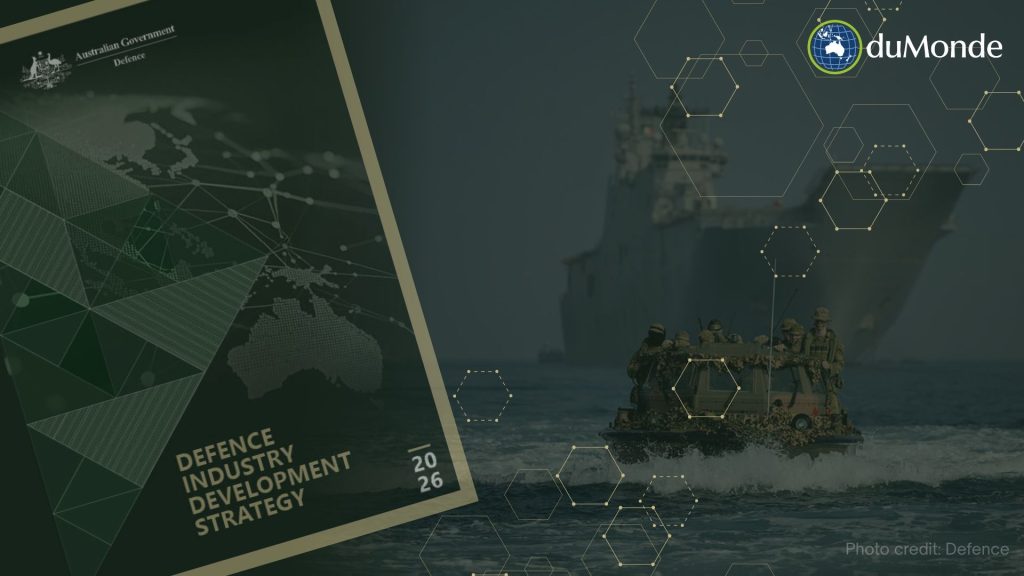

The release of the 2026 Defence Industry Development Strategy (DIDS) has generated significant discussion across the Australian defence sector. Official channels frame the strategy as a generational leap in self-reliance and procurement speed, while independent policy analysts have questioned whether the framework can truly overcome deep-seated bureaucratic risk-aversion or reduce systemic reliance on foreign multinational primes.
Regardless of where organisations sit in that debate, the immediate imperative for corporate leadership is to isolate the concrete operational and commercial mechanisms the DIDS 2026 sets in motion. Industry cannot afford to stall strategy while debating policy execution. Just as our previous analysis of the 2026–27 Defence Portfolio Budget highlighted that economic resilience and national security are now structurally intertwined, this strategy demands that leadership look past headline announcements and master the underlying systemic frameworks. Critically, the DIDS 2026 must be understood as an industry-shaping document just as much as it is a procurement strategy. Defence is explicitly signalling the exact type of industrial ecosystem it intends to build, and organisations must align their corporate structures accordingly.
The Sovereign Paradox: Broad Definitions vs. Narrow Interventions
The Commonwealth’s unchanged definition of the Sovereign Defence Industrial Base remains a foundational baseline for industry. The policy explicitly reiterates that Australian ownership is only critical to sovereignty in “limited circumstances,” continuing to include foreign-owned subsidiaries and landed entities as sovereign assets, provided they maintain local capital, workforce, and leadership.
From a governance and guidance perspective, the strategy introduces a deliberate framework to manage this baseline through the Seven Sovereign Defence Industrial Priorities (SDIPs). By categorising specific capabilities into distinct “Grow” and “Guide” quadrants, this is Defence approach to prioritisation and is signalling precisely where it will actively intervene to enforce domestic participation versus where it will rely on global market forces:
- The “Grow” Quadrant (Active Intervention): Critical capabilities with higher difficulty to establish onshore—such as domestic GWEO component manufacturing and autonomous systems integration—will receive direct, targeted Commonwealth funding and active intervention.
- The “Guide” Quadrant (Commercial Frameworks): Capabilities that are less complex to scale will be supported through standard contractual mandates requiring the use of the sovereign base under the existing Australian Industry Capability (AIC) program.
For Australian SMEs and Tier 2 suppliers, the strategic path forward requires aligning internal capability and business development pipelines precisely with these documented lifecycle requirements to remain competitive.
Structural Reform and the Pivot to Portfolio Stewardship
The structural overhaul of Defence’s procurement architecture represents a profound shift in how the Commonwealth intends to manage its industrial base. The establishment of the interim Defence Delivery Group, transitioning to a formalised Defence Delivery Agency (DDA) by 1 July 2027, marks a fundamental separation of powers: the Vice Chief of the Defence Force (VCDF) retains absolute accountability for requirements development, while the DDA operates under the National Armaments Director as a dedicated Industry Steward.
| CAPABILITY ACQUISITION RESTRUCTURE | |
| REQUIREMENTS DEFINITION Accountability: VCDF (Defines Military Need) | DELIVERY & PERFORMANCE Accountability: DDA (Portfolio Industry Steward) |
This structural shift underpins the move toward portfolio-level Industrial Development Agreements with Tier 1 primes. This is not simply an organisational restructure; it represents an intentional transition towards true portfolio stewardship, enterprise performance, and longer-term industry relationships. The pragmatic business implication is that prime contractors face heightened accountability to provide clear demand signals and meet strict workforce growth targets for apprentices, trainees, and interns. Consequently, mid-tier and SME organisations must position themselves to plug into these enduring enterprise frameworks rather than relying on short-term project cycles.
Operational Realities and Commercial Watchpoints
Navigating the DIDS 2026 environment requires boards and executive teams to monitor several systemic operational watchpoints:
- The Cyber Security Threshold: The implementation of the Cyber Uplift Program means Defence Industry Security Program (DISP) members face mandatory benchmarking against Essential Eight Level 2 mitigations. While expansion grants are available, the cost of compliance remains a major commercial hurdle for smaller Tier 3 suppliers trying to enter or remain in the supply chain.
- The Information Classification Dilemma: Deteriorating strategic circumstances have led Defence to reduce the volume of unclassified capability information in the public domain. Moving communication to Classified Forums means businesses without rapid DISP pathways risk experiencing a critical lag in pipeline visibility.
- Workforce Scale Constraints: The strategy’s focus on mega-projects, such as AUKUS Pillar One, requires an intense focus on specialised skill acquisition. Replicating the South Australian Workforce Taskforce model nationally is a step toward mapping long-term demand, but immediate skills competition remains severe.
Boardroom Directives: Tangible Governance Implications
Given the depth of these shifts, boards and executive leadership teams should immediately initiate a formal review of their strategic posture. Sound governance now requires a comprehensive audit across five critical areas:
- Sovereign Partnerships: Assessing existing joint ventures and international primes to ensure alignment with the DIDS definition of landed capability.
- Workforce Strategy: Evaluating training pipelines and internal retention models against national taskforce benchmarks and prime contractor mandates.
- Cyber Maturity: Validating timelines and capital expenditure allocations required to meet Essential Eight Level 2 baselines under the Cyber Uplift Program.
- Capability Investment Priorities: Ensuring that corporate internal capability maps directly to the refined lifecycle requirements of the seven SDIP domains.
- Strategic Alignment: Auditing overall commercial focus to match Defence’s long-term pivot toward a focused, integrated force.
The Strategic Directive for Industry
Whether one views the DIDS 2026 as a necessary modernisation of procurement practices or a continuation of risk-averse policy, its mandates are now the baseline for doing business with Defence.
Future commercial success in this environment will be driven by sustained investment in organisational capability, trusted delivery, cyber resilience, and long-term alignment with Defence priorities. Industry leadership must actively leverage the new Defence Industry Hub for data-driven maturity assessments and adapt their commercial strategies to the realities of a focused force.
The organisations that succeed over the coming decade will not necessarily be those with the largest contracts today, but those that adapt earliest to Defence’s evolving operating model. DIDS 2026 should therefore be viewed less as a policy document and more as a strategic roadmap for how Defence intends to select, develop, and sustain its future industrial partners.


